




dinara56437
23.01.2021 04:39

Earthlings are remotely probing the planetary system of the star Prob of the Measure galaxy for the content of hydrogen in the atmosphere. One signal is sent to each planet. On the way back, the signal passes through a relay station located at the edge of the solar system, and with a probability of 0.1 does not reach the Earth. All obtained results are saved on this station. If the sensing result that came to the Earth indicates that the percentage of hydrogen is above a certain threshold (a positive result), then a probe will be automatically sent to this planet from the Earth for a more detailed study (the probe, in particular, accurately determines the hydrogen content in the atmosphere planet and transmits the corresponding signal to Earth without interference). If the result is negative, the probe is not sent. In the event of a signal loss during transmission through an intermediate station, the machine decides to send a probe, throwing in the correct bone: if 6 falls out, then the probe is sent, otherwise it is not sent. The remote sensing method is not accurate: if the sensing result is positive, then in fact the percentage of hydrogen exceeds a predetermined threshold with a probability of 0.8; if the sounding result is negative, then in fact the percentage of hydrogen does not exceed the specified threshold with a probability of 0.95. Based on the data stored at the relay station in the study of similar planetary systems of the Measure galaxy, for any planet of the Prob star system, the result of remote sensing is expected to be positive with a probability of 0.3. a) What is the likelihood that a probe sent to some planet W will report that the percentage of hydrogen in the atmosphere of W is above a certain threshold? b) What is the probability that a probe will be sent to some planet U randomly selected from the studied planetary system? c) The result of remote sensing of planet Y of the Prob star system did not reach Earth. A probe was sent to Y, which gave us accurate information that the percentage of hydrogen in the atmosphere of Y is sufficient. What is the likelihood that the result of its remote sensing stored at the intermediate station was positive? d)A probe was sent to planet Z and reported that the percentage of hydrogen was insufficient. What is the likelihood that we received a remote sensing of planet Z? Note:Enter a decimal with a dot followed by four decimal places, for example, 0.3571.

Нажмите на рекламу ниже и сразу увидите ответ
Популярные вопросы:
Ответ:
dalnik38
28.04.2020 00:36

Нехай за x год перший робітник виконає завдання, а за y год — другий. Тоді за одну годину перший робітник виконає \dfrac{1}{x} усього завдання, а другий робітник — \dfrac{1}{y}.

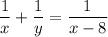
Два робітники, працюючи разом, можуть виконати завдання на 8 год швидше, ніж один перший робітник, тобто \dfrac{1}{x} + \dfrac{1}{y} = \dfrac{1}{x-8}
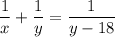
Два робітники, працюючи разом, можуть виконати завдання на 18 год швидше, ніж один другий робітник, тобто \dfrac{1}{x} + \dfrac{1}{y} = \dfrac{1}{y-18}
Складаємо систему з двох рівнянь:

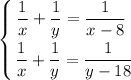
\displaystyle \left \{ {{\dfrac{1}{x} + \dfrac{1}{y} = \dfrac{1}{x-8} \ } \atop {\dfrac{1}{x} + \dfrac{1}{y} = \dfrac{1}{y-18}}} \right.

Тут \dfrac{1}{x - 8} = \dfrac{1}{y - 18} \Rightarrow x - 8 = y - 18 \Rightarrow x = y - 10, оскільки ліві частини рівнянь рівні.

Підставимо x = y - 10 в перше рівняння:

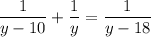
\dfrac{1}{y - 10} + \dfrac{1}{y} = \dfrac{1}{y - 18}

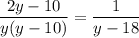
\dfrac{2y - 10}{y(y-10)} = \dfrac{1}{y - 18}

(2y - 10)(y - 18) = y(y - 10)

2y^{2} - 46y + 180 = y^{2} - 10y

y^{2} - 36y + 180 = 0

y_{1} = 6; \ y_{2} = 30

Якщо y_{1} = 6, то x_{1} = 6 - 10 = -4 — не відповідає сенсу задачі.

Якщо y_{2} = 30, то x_{2} = 30 - 10 = 20

Отже, за 20 год перший робітник виконає завдання, а за 30 год — другий.

Відповідь: 20 год і 30 год.

0,0(0 оценок)
Ответ:
Антон11111111112
22.04.2020 05:40

1)Пусть катеты х см и у см.Тогда,если периметр 40,а гипотенуза 17,то х+у=40-17=23,а 

у=23-х.По теореме Пифагора x^2-(23-x)^2=17^2

                                             x^2-23x+120=0

                                         если x=15 ,то у=8 и наоборот.

 2)Обозначим производительность первой трубы через х,а второй-через у.При этом выполненную работу принимаем за 1.Работая вместе,(х+у),вся работа выполнена за 4 часа:   1/(х+у)=4.

Работая отдельно,вторая труба наполняет дольше,чем первая на 6 часов.Тогда время работы второй трубы найдем,как 1/у,а первой-  1/х и (1/у)-(1/х)=6

Решаем систему

4х+4у=1           х=1/4-у                    ...   24у^2-14y+1=0     

 х-у=6ху          1/4-у-у=6у(1/4-у)      ...    у(1)=1/2 НЕ

УДОВЛЕТВОРЯЕТ УСЛ.ЗАДАЧИ,у(2)=1/12,тогда х(2)=1/4-1/12=1/6 это производительности второй(у2) и первой(х2) труб.А чтобы узнать время работы первой трубы,надо работу(единицу) разделить на производительность,т.е.

1/( 1/6)=6(часов) первая труба самостоятельно наполнит бассейн



0,0(0 оценок)
Полный доступ
Позволит учиться лучше и быстрее. Неограниченный доступ к базе и ответам от экспертов и ai-bota Оформи подписку
logo
Начни делиться знаниями
Вход Регистрация
Что ты хочешь узнать?
Спроси ai-бота