





yanamalykh
10.11.2020 13:10

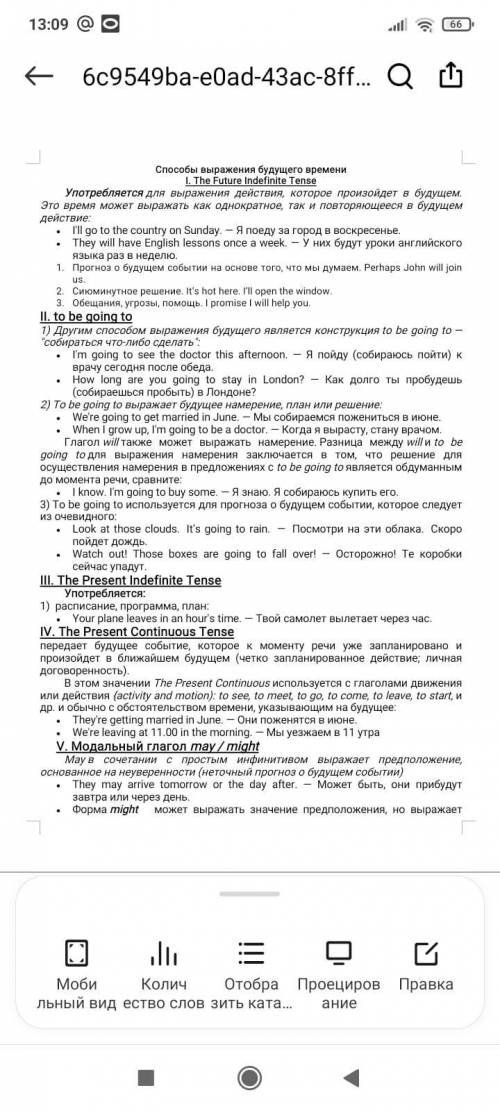
Ways of Expressing the Future Tense I. The Future Indefinite Tense
It is used to express an action that will happen in the future.
This time can express both a single and repeated
action in the future:
• I'll go to the country on Sunday. - I'm going out of town on Sunday.
•They will have English lessons once a week. - They will have English lessons
language once a week.
1. Forecast about the future event based on what we think. Perhaps John will join
us.
2. A momentary solution. It's hot here. I'll open the window.
3. Promises, threats, help. I promise I will help you.
II. to be going to
1) Another way of expressing the future is the construction to be going to -
"going to do something":
• I'm going to see the doctor this afternoon. - I'm going (going to go) to
the doctor this afternoon.
How long are you going to stay in London? - How long will you stay
(are you going to stay) in London?
2) To be going to expresses a future intention, plan or decision:
• We're going to get married in June. - We are going to get married in June.
• When I grow up, I'm going to be a doctor. - When I grow up, I will become a doctor.
The verb will can also express intent. The difference between will and to be
going to for the expression of intention is that the decision to
implement the intention in sentences with to be going to is deliberate
until the moment of speech, compare:
• I know. I'm going to buy some. - I know. I'm going to buy it.
3) To be going to is used to predict a future event, which follows
from the obvious
• * Look at those clouds. It's going to rain. - Look at these clouds.
It's going to rain soon.
Watch out! Those boxes are going to fall over! - Careful! Those boxes
are about to fall.
III. The Present Indefinite Tense
Used:
1) schedule, program, plan:
• Your plane leaves in an hour's time. - Your plane departs in an hour.
IV. The Present Continuous Tense
conveys a future event that is already planned by the time of the speech and
will happen in the near future (clearly planned action; personal
agreement).
In this sense, The Present Continuous is used with verbs of movement
or action {activity and motion): to see, to meet, to go, to come, to leave, to start,
etc. and usually with a circumstance of time indicating the future:
They're getting married in June. - They're getting married in June.
• We're leaving at 11.00 in the morning. - We leave at 11 a.m.
V. Modal verb may/might
Mau in combination with a simple infinitive expresses an assumption
based on uncertainty (an inaccurate forecast about a future event)
They may arrive tomorrow or the day after. - Maybe they will arrive
tomorrow or the next day.
* The might form may express the meaning of the assumption, but expresses
Moby
Number of
The selection of the projected Edit
the visual appearance of the words zit kata...
ta…
current


Ways of Expressing the Future Tense I. The Future Indefinite Tense It is used to express an action t

Нажмите на рекламу ниже и сразу увидите ответ
Популярные вопросы:
Ответ:
хомяк2005
17.03.2023 11:08

Перевод:

Когда поршень снова достигает верхней мертвой точки, свечи зажигания воспламеняют смесь, оба клапана закрываются во время сгорания. В результате горения смеси газы расширяются, и большое давление заставляет поршень двигаться вниз по цилиндру. Этот ход называется силовым ударом. Когда поршень достигает нижней точки своего хода, выпускной клапан открывается, давление сбрасывается, и поршень снова поднимается. Это позволяет сгоревшему газу течь через выпускной клапан в атмосферу. Это называется выхлопной печью, которая завершает цикл. Таким образом, поршень перемещается в цилиндре вниз (такт впуска), вверх (такт сжатия), вниз (рабочий ход), вверх (такт выпуска). Тепло, выделяемое топливом, преобразуется в работу, так что возвратно-поступательное движение поршней преобразуется во вращательное движение коленчатого вала с шатунов.

Вопрос-ответ:

1) As the piston again reaches the top dead center the spark plugs ignite the mixture.

2) High pressure causes the piston to move down the cylinder.

3) When the piston reaches the bottom of its stroke, the exhaust valve opens, the pressure is released, and the piston rises again.

4) The drain that completes the cycle is called the exhaust furnace.

5) The piston moves in the cylinder down (intake stroke), up (compression stroke), down (stroke), up (exhaust stroke).

5 вроде так :>

0,0(0 оценок)
Ответ:
Alisherjon1985
03.07.2020 03:40
1) He usually (goes) to school by bus, but today he (is walking) to school. 2) Listen! The birds (is singing). They always (sing) in the morning. 3) What (are you / doing)? Do you always (work) like that? 4) I (do not / swim) in this lake! It (is) far too cold. 5) Peter (has just / eaten) his school dinner, but I (think) school dinners (taste) horrible. 6) The girls often (do) their homework together, but today they (are not / doing) their homework properly! 7) I sometimes (go) for a walk in the afternoons, but today I (am working) instead. 8) Christiana always (feeds) her cows in the morning, but Tim (is feeding) them today. 9) Look! (Isn't ) that Sarah? She (is just / going) into the cinema with her boyfriend. 10) Dad (does not / know) that Tom (has run) in a marathon today. He will be surprised.
0,0(0 оценок)
Полный доступ
Позволит учиться лучше и быстрее. Неограниченный доступ к базе и ответам от экспертов и ai-bota Оформи подписку
logo
Начни делиться знаниями
Вход Регистрация
Что ты хочешь узнать?
Спроси ai-бота