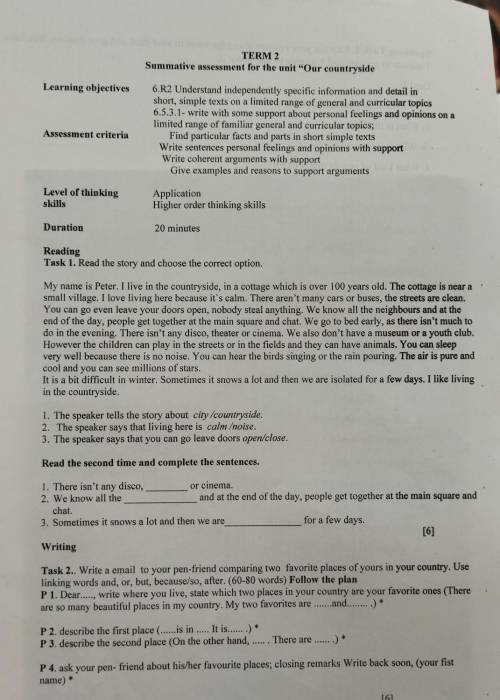
Reading Task 1. Read the story and choose the correct option. My name is Peter. I live in the countryside, in a cottage which is over 100 years old. The cottage is near a small village. I love living here because it's calm. There aren't many cars or buses, the streets are clean. You can go even leave your doors open, nobody steal anything. We know all the neighbours and at the end of the day, people get together at the main square and chat. We go to bed early, as there isn't much to do in the evening. There isn't any disco, theater or cinema. We also don't have a museum or a youth club. However the children can play in the streets or in the fields and they can have animals. You can sleep very well because there is no noise. You can hear the birds singing or the rain pouring. The air is pure and cool and you can see millions of stars. It is a bit difficult in winter. Sometimes it snows a lot and then we are isolated for a few days. I like living a in the countryside. 1. The speaker tells the story about city/countryside. 2. The speaker says that living here is calm /noise. 3. The speaker says that you can go leave doors open/close. Read the second time and complete the sentences. 1. There isn't any disco, or cinema. 2. We know all the and at the end of the day, people get together at the main square and chat. 3. Sometimes it snows a lot and then we are for a few days. [6]
I remember when I 1) went (go) on holiday abroad for the first time. I 2) had just left (just/leave) school. I 3) studied (study) very hard for my final exams and I 4) felt (feel) that I needed to get away. A friend of mine 5) wanted (want) to go away as well so we 6) decided (decide) to look some brochures at a travel agent's. We 7) had searched/had been searching (search) for about an hour when my friend 8) found (find) the perfect holiday - two weeks in Cuba. We 9) were (be) very excited about it. Finally the day of our holiday 10) arrived (arrive). We 11) had just left (just/leave) the house when the phone 12) rang (ring). I 13) ran (run) back into the house, but the phone 14) had stopped (stop) by the time I 15) reached (reach) it. When we 16) got (get) at the airport, we 17) checked (check) in and18) went (go) to the cafeteria. While we were having our coffee, the airline 19) made (make) an announcement. Our flight was delayed for eight hours. It was then that I 20) realised (realise) what the phone call was about. We 21) got up (get up) very early and rushed to the airport, all for nothing.
Степени: сравнительная и превосходная 1) если прилагательное состоит из 1 или 2 слогов, нужно добавлять окончания: -еr (для сравнительной), -est ( для превосходной), заметим, что в превосходной степени нужен артикль (the) Пример: big- bigger(сравнительная)- the biggest( превосходная) 2) если в прилагательном более 2 слогов, используем служебные слова: more (для сравнительной), most (для превосходной), артикль также нужен для превосходной Пример: difficult- more difficult- the most difficult 3) следует запомнить исключения: Good- better- the best Bad- worse- the worst Little- less- the least
*more- более *most- наиболее, самый
0,0(0 оценок)
Полный доступ
Позволит учиться лучше и быстрее. Неограниченный доступ к базе и ответам от экспертов и ai-bota
Оформи подписку