SUMMATIVE ASSESSMENT FOR TERM 4 Learning objectives 6.4.2.1 (6.R2) Understand independently specific information and detail in short, simple texts on a limited range of general and 6.5.6.1 (6.W6) Link, with minimal support, sentences into coherent paragraphs using basic connectors on a growing range of familiar general topics Assessment criteria • Identify particular facts and parts in reading passage • Read and discuss about cultural diversity
Level of thinking skills Application Higher order of thinking
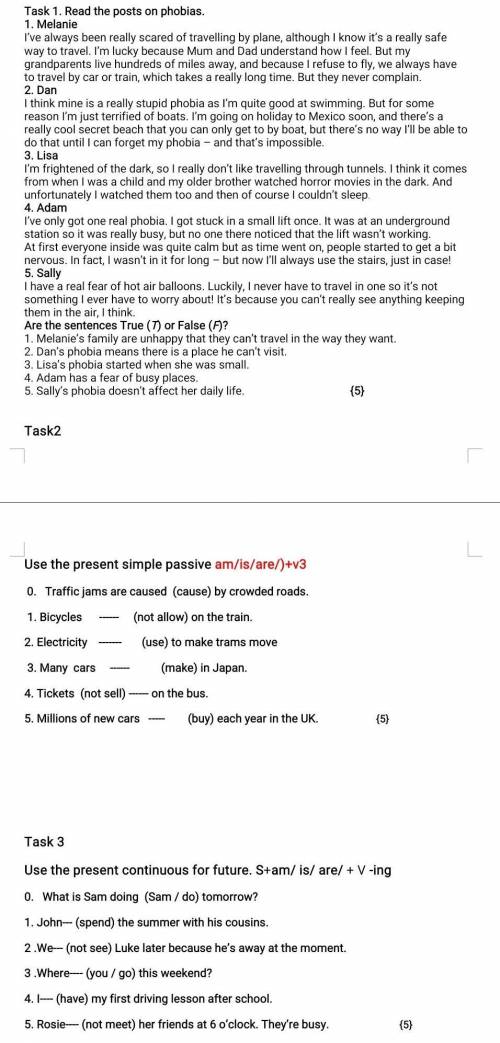
Task 1. Read the posts on phobias. 1. Melanie I’ve always been really scared of travelling by plane, although I know it’s a really safe way to travel. I’m lucky because Mum and Dad understand how I feel. But my grandparents live hundreds of miles away, and because I refuse to fly, we always have to travel by car or train, which takes a really long time. But they never complain. 2. Dan I think mine is a really stupid phobia as I’m quite good at swimming. But for some reason I’m just terrified of boats. I’m going on holiday to Mexico soon, and there’s a really cool secret beach that you can only get to by boat, but there’s no way I’ll be able to do that until I can forget my phobia – and that’s impossible. 3. Lisa I’m frightened of the dark, so I really don’t like travelling through tunnels. I think it comes from when I was a child and my older brother watched horror movies in the dark. And unfortunately I watched them too and then of course I couldn’t sleep. 4. Adam I’ve only got one real phobia. I got stuck in a small lift once. It was at an underground station so it was really busy, but no one there noticed that the lift wasn’t working. At first everyone inside was quite calm but as time went on, people started to get a bit nervous. In fact, I wasn’t in it for long – but now I’ll always use the stairs, just in case! 5. Sally I have a real fear of hot air balloons. Luckily, I never have to travel in one so it’s not something I ever have to worry about! It’s because you can’t really see anything keeping them in the air, I think. Are the sentences True (T) or False (F)? 1. Melanie’s family are unhappy that they can’t travel in the way they want. 2. Dan’s phobia means there is a place he can’t visit. 3. Lisa’s phobia started when she was small. 4. Adam has a fear of busy places. 5. Sally’s phobia doesn’t affect her daily life. {5}
Task2 Use the present simple passive am/is/are/)+v3 0. Traffic jams are caused (cause) by crowded roads. 1. Bicycles (not allow) on the train. 2. Electricity (use) to make trams move 3. Many cars (make) in Japan. 4. Tickets (not sell) on the bus. 5. Millions of new cars (buy) each year in the UK. {5}
Task 3 Use the present continuous for future. S+am/ is/ are/ + V -ing 0. What is Sam doing (Sam / do) tomorrow? 1. John--- (spend) the summer with his cousins. 2 .We--- (not see) Luke later because he’s away at the moment. 3 .Where (you / go) this weekend? 4. I (have) my first driving lesson after school. 5. Rosie (not meet) her friends at 6 o’clock. They’re busy. {5}
My favorite film is Hobbit. This film was made in 2012. I like this film because of its good plot and bright scenes. The main idea of this film is that one guy rememberes about his life, he remembers that he has to find the ring of Orks. Finally, main characters of this film see how a dragon is wake up. Actually the end of my favorite film is the begining of famous trilogy "Lords of rings" which every person likes too much! I have wathed this film several monthes ago in the cinema. However, I still have a lot of positive emotions and I will recomment this folm to my relatives and friends.
Institute of Industrial Ecology , Ural Branch of Russian Academy of Sciences established in 1992 , the Scientific and Engineering Centre for Environmental Safety UB RAS .Creation and establishment of the Institute coincided with a difficult period in the life of our country . This could not but affect the choice of research subjects and the nature of tasks. It was necessary to move to a qualitatively different level of abstraction to see the place in a number of environmental problems all others: medical, social, economic, demographic , etc. , and see the relationship and interdependence. The first step in understanding this is done.The main conclusion - an efficient solution of large-scale multi-factorial and diverse ekologoobuslovlennyh problems is possible only through an integrated system approach .Effectively solve problems separately:environmental - based only on ecological principles ;economic - considering only the economic aspects;medical - considering only health problems , etc. , it is impossible . This is due to the fact that , as a rule , environmental problems are solved in the complex in order to , for example, improving public health , economic or demographic situation , quality of life , etc. But when we link the state of the environment and public health, the environment and the economy begin to act out their criteria and principles that are different from purely environmental, health , economic principles , such as prioritization .The challenge now facing the team of the Institute - based on the principles of system analysis to develop a methodology for solving complex problems and ekologozavisimyh at levels from local, regional and higher.
0,0(0 оценок)
Полный доступ
Позволит учиться лучше и быстрее. Неограниченный доступ к базе и ответам от экспертов и ai-bota
Оформи подписку