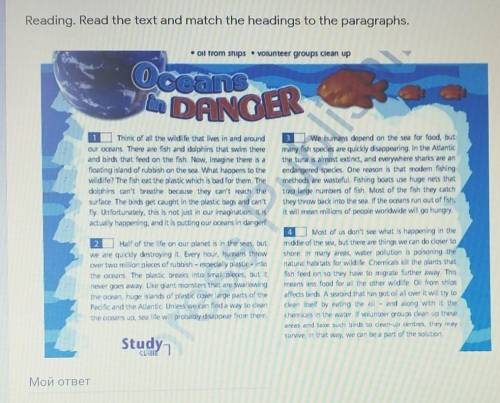
Reading. Read the text and match the headings to the paragraphs. oll from ships volunteer groups clean up Oceans Le DANGER 1 Think of all the widife that lives in and around our oceans. There are fish and dolphins that swirn there and birds that feed on the fish. Now, imagine there is a foating sand of rubbish on the sea. What happens to the widife? The fish eat the plastic which is bad for them. The dolphins can't breathe because they can't reach the surface. The birds get caught in the plastic bags and can't fly Unfortunately, this is not just in our imagination. It is actua ly happening, and it is putting our ocears in danger! 3 We humans depend on the sea for food, but many fish species are quickly disappearing in the Atlantic the tuna is almost extinct, and everywhere sharks are an endangered species. One reason is that modern fishing methods are wasteful Fishing boats use huge nets that trap large numbers of fish. Most of the fish they catch they throw back into the sea If the oceans run out of fish, it will mean millions of people worldwide will go hungry 2 Haf of the life on our planet is in the seas, but ve are quickly destroying it Every hour, humars throw over two on piece of rubbish - especialy plastic-into the oceans The past breaks into smal pieces, but it never goes away Like gant monsters that are swallowing the ocean, huge sands of plastic cover age parts of the Pacific and the Aslantic Unless we can find a way to dean the oceans up, sea few probably disappear from then 4 Most of us don't see what is happening in the middle of the sea, but there are things we can do coser to shore in many areas, water pollution is poisoning the natural habitats for wild fe Chemica's ka the plants that fish feed on so they have to migrate further away This means less food for all the other wid fe Oil from ships affects birds. A seabird that has got ol all over it will try to clean itself by eating the ol - and along with it the chemicals in the water. If volunteer groups dean up these arces and take such birds to dean-up centres, they may survive in that way, we can be a part of the solution Study Site Мой ответ
1. I once ( knew) a village teacher who (was) partially blind. He (had been deprived) of one eye as the result of infection. His blind eye (had been taken) out, and a glass one ( inserted) in its socket instead. One day the teacher ( needed) to leave his class of small children alone for half an hour or so. But he (was held) back by one consideration. The children of the class (were) really unruly. He ( knew) that if they (were left) alone for any length of time they (would become) violent and complaints (would be make) by their parents. Suddenly he (was striken) by an idea. In a moment his glass eye (was taken) out of its socket, and ( placed) on the table. “Now, children”, he said, “I (am going) out for a few minutes but you (will be observed) all the time by my eye. If anything (is done) which (has not been approved) by me it (will be seen) by my eye, and the child (will be punished) when I (return). The children (were impressed) very much, and the teacher (went) off. But when he ( returned) an hour later it ( seemed) that a hurricane (had passed) through the classroom. The teacher (was astounded). “Evidently”, he thought,”I (have been outwited). I wonder how”. In the classroom the tables (were overturned), the walls ( spattered) with ink from ink-bombs which (had been thrown) during the battle which still (was being fought) out as a manifestation of high spirits. In fact, a good time (had been had) by all. The teacher ( wondered) why the presence of his glass eye (was not respected). He ( looked) round for it and ( saw) that it (was covered) by a hat.
1. The customer didn’t understand why the Sellers (had increased) the unit price. 2. He wasn’t sure if they (would pay) them any compensation for the damaged samples. 3. They informed that they (had redesigned) the old model. 4. He told us that he had already ( checked) in his luggage. 5. She asked if he (had payed) an excess baggage charge. 6. The passengers didn’t know where they (could) collect their luggage. 7. The Custom Officer was interested to know if I ( had) anything to declare. 8. The supplier admitted that they (had) a lot of orders to handle at that time. 9. The secretary said she (had lost) the price list somewhere in all the other papers. 10. He complained that they (were suffering) from strikes at the airport.1. Клиент не понимает, почему продавцы увеличили цену товара. 2. Он не был уверен, выплатят ли они им какую-либо компенсацию за поврежденные образцы. 3. Они сообщили, что они изменили старую модель. 4. Он сказал нам, что он уже сдал свой багаж. 5. Она спрашивает, оплатил ли он избыточный багаж. 6. Пассажиры не знали, где им забирать свой багаж. 7. Таможенник хотел знать, было ли у меня что декларировать. 8. Поставщик признал, что в то время у них было много заказов для исполнения. 9. Секретарь сказала, что она затеряла прайс-лист где-то в других бумагах. 10. Он что они страдали от забастовок в аэропорту.
0,0(0 оценок)
Полный доступ
Позволит учиться лучше и быстрее. Неограниченный доступ к базе и ответам от экспертов и ai-bota
Оформи подписку