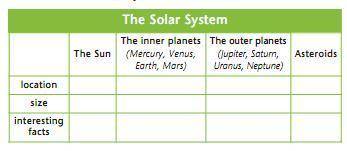
Ex. 1 p. 140 Read the interview about the solar system . Copy the diagram into your notebook and talk about the solar system using the points in it. Then, complete it with information about the solar system.
(the giagram is is below)
Interviewer: Welcome to The Science Show. Today I’m talking to Professor John Stewart about the solar system. So, Professor, tell me about the solar system. Where’s the best place to start?
Prof: With the Sun, of course. The Sun is at the centre of the solar system. It’s also the biggest object in it. In fact, the word ‘solar’ in ‘solar system’ means the Sun. Everything else in the solar system moves around it, including the eight planets.
Interviewer: Can you tell us something about the planets?
Prof: Of course. We can put the planets into two groups: the inner planets and the outer planets. I’ll start with the inner planets: Mercury, Venus, Earth and Mars. These are the planets that are closest to the Sun. They are also the smallest planets and they all have a rocky surface. The Earth is unusual because it’s got both water and ice, but Mercury and Mars have some ice on them too.
Interviewer: What about the outer planets? How are they different?
Prof: The outer planets are Jupiter, Saturn, Uranus and Neptune. They are great big balls of gas and they don’t have a solid surface. They can also be very stormy places. On Jupiter, there is a huge storm that is hundreds of years old. And on Neptune the winds can be faster than 1000 miles per hour.
Interviewer: Many of the planets also have moons, don’t they? Can you tell us about them?
Prof: Well the Earth is not the only planet in the solar system with a moon. The outer planets all have over ten moons each. Jupiter has the most with 67. They are not all as empty as the Earth’s Moon, though. We actually believe that one of Jupiter’s moons has a sea with a thick layer of ice on top.
Interviewer: So we’ve talked about the Sun, the planets and the moons. Is there anything else in the solar system?
Prof: Yes, there are asteroids. Asteroids are like planets, but smaller. Some are hundreds of miles across. Others are only a few metres wide. Millions of these asteroids move around the Sun between Mars and Jupiter. There’s also a large area of asteroids further out than Neptune. Four asteroids are so big that we call them dwarf planets. Scientists will probably find hundreds more dwarf planets in the future.
Interviewer: That’s fascinating, Professor. Stay with us, listeners, and we’ll be right back after the news.
Ex. 2 a) Read the extracts (A-B). Which is from the introduction of a presentation? Which is from the conclusion?
A Scientists have learned so much about our solar system already, and they are sure to make new and amazing discoveries in the future as well.
B What is always there, but we only see it during the day? It’s the Sun, of course! The Sun is the star at the centre of our solar system, and all of the planets, asteroids and moons move around it. Today I’m going to tell you more about our solar system and its parts.
Computers have had a great impact on society. Computers are used in everything Not only have computers had a great impact on our everyday life, but also on education and the workplace. The Internet has had a huge impact on society. Around the world, the Internet is available to millions of people. the majority of the information and services available are free in the Internet. The idea of remote learning can be applied everywhere. Although computers can cause some problems, such as unemployment and computer viruses, these are far outweighed by the benefits computers provide. computers and technology will continue to have an increasing effect on society
Компьютеры оказали большое влияние на общество. Компьютеры используются во всем.Компьютеры оказали большое влияние Не только на нашу повседневную жизнь, но и на образование и на рабочие места. Интернет оказал огромное влияние на общество. Во всем мире, Интернет доступен миллионам людей. Большинство информации и услуг, доступны бесплатно в Интернете. Идеи дистанционного обучения могут быть применены во всем мире. Хотя компьютеры могут вызвать некоторые проблемы, такие как безработица и компьютерные вирусы, они намного перевешивают преимущества которые компьютеры предоставляют. Компьютеры и технологии будут продолжать оказывать все большее влияние на общество
1. Tim does not his morning exercises every day. Тим не делает каждый день утреннюю зарядку. Does Tim do his morning...? What does Tim do every day? 2.He doesn't always smoke before lunch. Он не всегда курит до обеда. Does he always smoke before lunch? When does he always smoke? 3.Mary’s mother didn't teach her how to cook. Мама Мэри не учила её как готовить. Did Mary's mother teach her how to cook? Whom did Mary's mother how to cook? 4.Yesterday we spent a lot of money. (What?) 5.My sister will not wear her new dress. Моя сестра не будет носить её новое платье. Will your sister wear her new dress? When will your sister wear her new dress? 6.We shall not join them later. Мы не должны присоединиться к ним позже. Shall we join them later? Why shall we join them later?
0,0(0 оценок)
Полный доступ
Позволит учиться лучше и быстрее. Неограниченный доступ к базе и ответам от экспертов и ai-bota
Оформи подписку