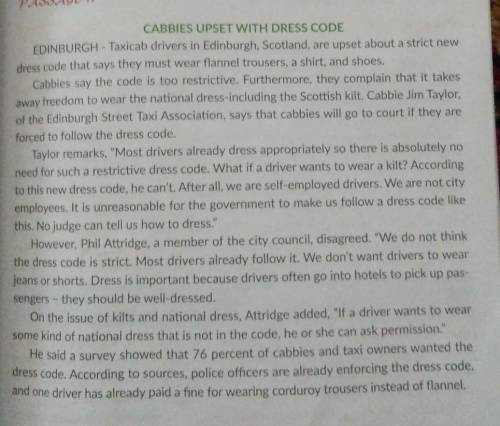
True /False 1. Cabbies are truck drivers 2. The dress code says that cabbies must wear kilts 3. Some cab drivers are unhappy about the dress code 4. Under the dress code, cabbies are not allowed to wear jeans 5. Cabbies who did not follow the dress code have to pay a fine
1. This time he is living in London. (Present Continuous Active) Сейчас он живет в Лондоне. 2. Who were you waiting for when I came? (Past Continuous Active) Кого ты ждал, когда я пришел? 3. Computers will be taking decisions for us in the future. (Future Continuous Active) В будущем компьютеры смогут принимать решения за нас. 4. His friend’s telephone number was forgotten by him. (Past Simple Passive) - Его номер телефона был забыт. 5. By the time I got to the plane it had already taken off. - (Past Perfect Active) К тому времени, когда я добрался, самолет уже взлетел. 6. In a fortnight’s time we will have taken our exams. (Future Perfect Active) Через две недели мы сдадим все экзамены. 7. The rooms were cleaned yesterday. (Past Simple Passive) - Комнаты были убраны вчера. 8. The translation is being done now. (Present Continuous Passive) - Перевод делают сечас. 9. The test had been finished when the teacher came. (Past Perfect Passive) - Когда учитель вошел, тест уже был сделан. 10. The apple pie will have been baked by 2 o’clock in the afternoon. (Future Perfect Passive) - Пирог будет приготовлен к 2м часам дня.
1. Serology is cheaper than the other diagnostic tests. Is serology cheaper than the other diagnostic tests? (Yes, it is/No, it isn't)
2. It requires a short execution time. Does it require a short execution time? (Yes, it does/No, it doesn't)
3. Human immunodeficiency virus can damage organs directly. Can human immunodeficiency virus damage organs directly? (Yes, he can/No, he can't)
4. The survival time and comfort of patients will depend greatly on therapies that prevent individual opportunistic infections. Will the survival time and comfort of patients depend greatly on therapies that prevent individual opportunistic infections? (Yes, it will/No, it won't)
5. Research into such therapies has expanded markedly in the past 5 to 10 years. Has research into such therapies expanded markedly in the past 5 to 10 years? (Yes, it has/No, it hasn't)
6. That filter stopped ordinary bacteria. Did that filter stop ordinary bacteria? (Yes, it did/No, it didn't)
7. Viruses come in all kinds of shapes. Do viruses come in all kinds of shapes? (Yes, they do/No, they don't)
0,0(0 оценок)
Полный доступ
Позволит учиться лучше и быстрее. Неограниченный доступ к базе и ответам от экспертов и ai-bota
Оформи подписку